Live: https://sunnatulla-vibe-rescue.netlify.app (runs entirely in your browser; first load is about 5 MB)
A static page that replays four bugs from my
Next.js + Supabase + Stripe rescue case study against
the case study's real SQL migrations. Each bug has a Before / After toggle: Before loads the broken migrations (v0-broken),
After loads the fixed ones (main), and the same requests run against both. (The public case-study repo holds a
snapshot of the fixed version; the broken migration is kept here in src/sql/before/.)
Postgres runs in your browser (PGlite, Postgres compiled to WebAssembly) in a Web Worker. There is no server, no Supabase project and no API key. This is a personal portfolio project, and all the data is sample data (two made-up users, Alice and Bob).
| # | Scenario | Before (v0-broken) |
After (main) |
|---|---|---|---|
| 1 | Bob (or anon) lists notes | Alice's note comes back | 0 rows |
| 2 | Bob inserts a note owned by Alice | Accepted; it shows up on Alice's dashboard | 42501 new row violates row-level security policy |
| 3 | Bob adds a 4th note, then sets his own plan to pro |
Both go through | 4th note refused by the insert policy; the update matches 0 rows |
| 4 | POST to the Stripe webhook handler | Forged events get 200; a real, signed payment updates 0 rows (runs as anon) |
No / bad signature: 400 with no SQL; signed payment: 200, Bob is on Pro |
Each step shows the client call (or HTTP request), the SQL that reached Postgres with the role and auth.uid()
it ran as, and the result. A persona switch (anonymous, Alice, Bob) re-runs scenarios 1 to 3 as that user.
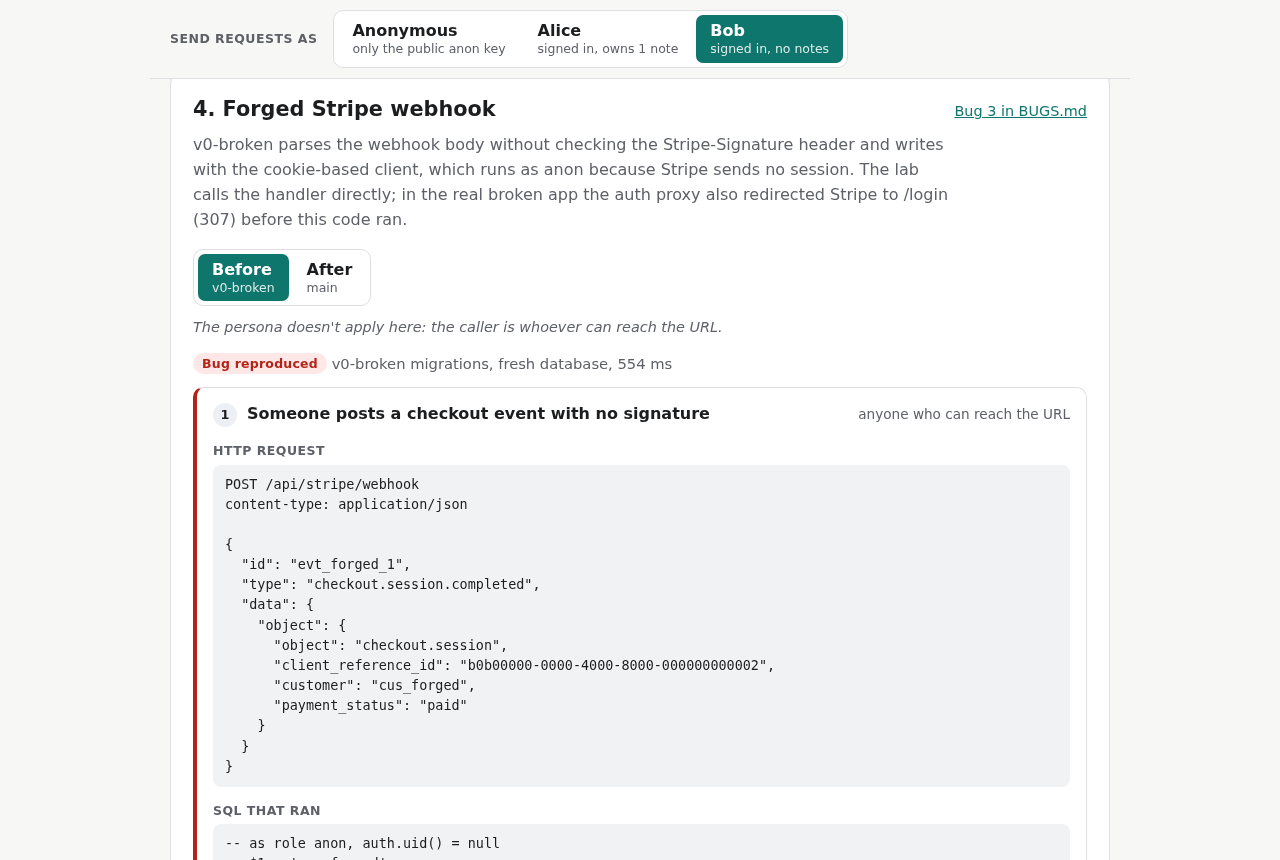
More in docs/screenshots: each scenario before and after, and the page on a phone in dark mode.
- The SQL is the case study's, unchanged.
src/sql/holds the Supabase stand-in from the case study's test suite (anon/authenticated/service_roleroles,auth.users,auth.uid()readingrequest.jwt.claims) and the migrations of both versions, already copied into this repo;src/sql/SOURCE.mdrecords where each file came from. (scripts/sync-sql.mjsis the script that copied them from my local working copy of the case study, which has the full history; the public snapshot repo doesn't, so you don't need it to run the lab.) - Requests run the way PostgREST runs them: one transaction per request,
set_config('request.jwt.claims', …)andset local role …, then the query. So RLS policies, the signup trigger and thesecurity definerpaywall function behave as they do on Supabase. PostgREST itself and Supabase Auth are not emulated: the lab sends the SQL that the client call turns into. - The webhook handlers are ports of
src/app/api/stripe/webhook/route.tsat both refs, with the same branches and status codes. The fixed one checks Stripe's signature scheme (t=…,v1=…, HMAC-SHA256 over"<t>.<raw body>", 5-minute tolerance) with Web Crypto. A test checks it against the Stripe SDK in both directions. The secret is a made-up test value and nothing talks to Stripe. - Every run starts from a fresh database. The worker builds each version once from the migrations, then clones it per run (about 0.5 s instead of 2 to 3 s), so runs never see each other's writes.
What the lab leaves out: bug 1 (auth redirect loop), bug 4 (env vars on deploy) and bug 5 (loading and error states) are about the Next.js app, not the database, so they are only in the case study. In the real broken app, bug 3 also showed up as a 307 redirect to /login for Stripe's request; the lab calls the handler directly.
Node 22 or newer.
npm install
npm run dev        # http://localhost:5173
npm test           # Vitest: every scenario before and after, webhook branches, signature vs the Stripe SDK
npm run check      # typecheck, lint, format check, tests, production build
npm run e2e        # after a build: headless Chrome flips every toggle, saves docs/screenshots/
No environment variables are needed. npm run build writes a static site to dist/ that any static host can
serve (it uses relative paths, so a subfolder works too). The PGlite WebAssembly and data files make it about
16 MB, about 5 MB gzipped, and they load once per visit.
src/sql/                  copied from the case study (do not edit; see SOURCE.md)
src/engine/database.ts    PGlite + shim + migrations + sample data; runs SQL as a persona
src/engine/scenarios.ts   the four scenarios, shared by the UI and the tests
src/engine/webhook.ts     the broken and fixed webhook handlers
src/engine/stripe-signature.ts  Stripe-Signature check with Web Crypto
src/worker.ts             Web Worker that owns Postgres
src/main.ts, src/ui/      the page (plain TypeScript and DOM, no framework)
test/                     Vitest
e2e/run.mjs               browser run (playwright-core + an installed Chrome; set CHROME_PATH)
scripts/sync-sql.mjs      copied the SQL from the case study's full-history working copy (not needed to run)
TypeScript, Vite, PGlite 0.5 (Postgres 18 in WebAssembly), Web Crypto, Vitest, ESLint, Prettier.
MIT. Written by Sunnatulla E. as a personal project.