An AI operations assistant for IT asset inventories. Ask it questions in plain language ("which laptops go out of warranty this quarter?"), have it take actions (check assets out and in, schedule maintenance), and run impact analysis over the dependency graph ("what breaks, and who is affected, if this switch dies?").
This repository is at milestone M4: evals and deploy prep, on top of the domain model and JSON API (M1), the agent (M2), and the web UI and MCP server (M3). All data is synthetic.
Ruby 3.2.3, Rails 8.1 (API mode), PostgreSQL 16, RSpec, Faker, the official Anthropic Ruby SDK (anthropic).
bin/setup            # installs gems, starts Postgres (docker compose), prepares and seeds the DB
bin/rails s          # http://localhost:3000
bundle exec rspec
Postgres runs from docker-compose.yml (docker compose up -d db or docker-compose up -d db).
Connection settings come from DB_HOST, DB_PORT, DB_USER, DB_PASSWORD
(defaults: localhost, 5432, postgres, postgres). The pg gem needs libpq headers
(brew install libpq on macOS; libpq-dev on Debian/Ubuntu).
Seeds are deterministic (Faker::Config.random = Random.new(42), logic in lib/seed_data.rb):
506 assets, 60 people, 9 locations, 12 services and 212 dependency edges. bin/rails db:seed wipes
the tables with RESTART IDENTITY, so ids are stable across reseeds too. Besides the random data
there is a small hand-named site, Data-Center-1, with DB-Server (AP-00502), Core-Switch-DC1,
two app servers, a backup NAS and a PDU; the agent replays refer to it.
Asset, Person, Location, Service, Checkout, MaintenanceTask, and Dependency, an
adjacency table with typed endpoints. A row reads "source depends_on / runs_on
target", where both ends are an Asset or a Service. If the target fails, the source is impacted.
| Endpoint | Notes |
|---|---|
GET /api/assets |
q (name, tag, serial), status, category, location_id, custodian_id, warranty_before=YYYY-MM-DD, page, per_page (max 100) |
GET /api/assets/:id |
includes the open checkout and maintenance tasks |
GET /api/people, /api/people/:id |
q, department |
GET /api/services, /api/services/:id |
criticality |
GET /api/impact/:type/:id |
type is asset or service; optional max_depth (default 10, max 25). Returns the impacted services, assets (with hop depth), people, counts and the edges between them (source depends on / runs on target) |
Impact analysis uses a recursive CTE that walks dependents of the node, tracks the path per branch to cut cycles, and stops at the depth limit. It returns the dependent services and assets (with their hop distance), plus the affected people: service owners and asset custodians.
curl localhost:3000/api/impact/asset/42?max_depth=5Ask questions in plain language; the agent answers with the inventory tools and streams its work as Server-Sent Events. Every run and every step is stored.
No Anthropic key is needed to see it work. Without one, a known prompt is replayed from a
recording in db/replays/ through the same streaming pipeline a live run uses:
bin/rails s
curl -s localhost:3000/api/agent/replays                    # the 8 replayable prompts
curl -s -XPOST localhost:3000/api/agent/runs -H 'content-type: application/json' \
     -d '{"prompt":"What breaks if DB-Server goes down?"}'   # -> {"data":{"id":1,"mode":"replay",...}}
curl -N "localhost:3000/api/agent/runs/1/stream?speed=2"     # SSE; speed scales the recorded timings
Replayable prompts (matching ignores case and punctuation; each has a few aliases):
| Prompt | Tools used |
|---|---|
| What breaks if DB-Server goes down? | impact_analysis |
| Which laptops are overdue and who has them? | search_assets |
| Check in asset AP-00014 | checkin_asset |
| Schedule maintenance for assets with expired warranty in Data-Center-1 | search_assets, schedule_maintenance |
| Summarize the fleet | summarize_fleet |
| Check out an available MacBook Pro to Shannon Kuhn for two weeks | search_assets, checkout_asset |
| Check out AP-00016 to Marguerite Little | checkout_asset (fails: already out), search_assets |
| What happens if the Email Gateway goes down? | impact_analysis |
The recordings are synthetic, and labelled as such ("recorded": "synthetic" on the fixture,
the run and the done event). No real key was available when they were made, so rake replays:build
reseeds the database inside a rolled-back transaction with the clock frozen at 2026-11-05 10:00 UTC,
executes each scenario's tool calls for real, and composes the assistant text from a template over
the actual results. Tool inputs and outputs are therefore genuine for the seeded data; the prose is
not model output, the timings are plausible estimates plus measured tool durations, and token usage
is estimated. rake replays:verify (also run by the spec suite) re-executes every recorded tool call,
requires identical output, and rebuilds each fixture. Replaying never executes tools, so replaying
"Check in asset AP-00014" does not change the inventory.
Send your Anthropic API key in the x-anthropic-key header. A live run executes when its stream is
opened, so the stream request carries the key too; nothing holds it between the two requests.
curl -s -XPOST localhost:3000/api/agent/runs -H "x-anthropic-key: $KEY" \
     -H 'content-type: application/json' -d '{"prompt":"Which servers in Data-Center-1 are out of warranty?"}'
curl -N localhost:3000/api/agent/runs/2/stream -H "x-anthropic-key: $KEY"
In development only, ANTHROPIC_API_KEY is used when the header is absent. Pass "mode":"replay"
to replay a known prompt even when a key is present.
The key is never stored or logged. It lives in a local variable for the request and is passed to
the SDK client. x-anthropic-key is in filter_parameters (in case a client sends it as a parameter),
the rate limiter buckets by its SHA-256, and API error messages are scrubbed before they are saved. A
spec (spec/requests/agent_byok_spec.rb) runs a full live run through the real SDK against a stubbed API
and asserts the key appears in no log line, no row of any table, and no SSE frame.
Rate limits (Rails 8 rate_limit, per key, or per IP without one): 10 run creations and 30 stream
opens per minute (AGENT_RATE_LIMIT, AGENT_STREAM_RATE_LIMIT), answered with HTTP 429.
| Endpoint | Notes |
|---|---|
POST /api/agent/runs |
{prompt, mode?, replay?}. 201 with the run and its stream_url; 422 with the replay catalog when there is no key and the prompt is unknown |
GET /api/agent/runs/:id/stream |
SSE. Executes a queued run (live needs the key header; replay takes speed, default 1). A finished run re-streams from its stored steps |
GET /api/agent/runs/:id |
the run (status, model, mode, usage, timings) and its ordered steps |
GET /api/agent/replays |
replayable prompts |
Stream events, each event: <name> plus one JSON data: line:
| Event | Data |
|---|---|
progress |
{step, delta}: the model's short "what I'm doing next" notes between tool calls |
text |
{step, delta}: answer text, streamed as it is generated |
tool_call |
{step, id, name, input} |
tool_result |
{step, tool_use_id, name, is_error, output, duration_ms} |
error |
{step, code, message}, e.g. invalid_api_key, refusal, iteration_cap |
done |
{id, status, mode, recorded, model, iterations, stop_reason, usage, duration_ms, steps} |
Plain Ruby service objects in app/services/tools/, each unit-tested. The model gets their JSON schemas
with strict: true. Keywords strict tool use does not support (numeric bounds, string and array lengths)
are removed from the schema sent to the model and enforced locally with json_schemer before the tool runs.
Tools never raise. They return {"ok": true, "data": ...} or
{"ok": false, "error": {"code", "message", "details"}}, which becomes an is_error tool result.
| Tool | Does |
|---|---|
search_assets |
filters: text, category, status, location, custodian, warranty expired/active/expiring within N days, overdue; ≤ 50 results |
get_asset |
one asset by tag, id or name: custodian, open checkout, maintenance, direct dependencies and dependents |
checkout_asset |
mutating; rejects assets already out, retired or in maintenance, unknown or ambiguous people, due dates outside 1-180 days |
checkin_asset |
mutating; closes the open checkout, reports lateness |
schedule_maintenance |
mutating; one task per asset, all-or-nothing on unknown assets, skips retired assets and duplicates |
impact_analysis |
M1's recursive CTE by asset or service name, with counts, criticality breakdown and people to notify |
summarize_fleet |
fleet or per-location aggregates: status, category, location, warranty, checkouts, maintenance, services |
Agent::Runner is a manual tool-use loop over the SDK's streaming helper
(client.beta.messages.stream). The parameters follow Anthropic's claude-api skill:
- Model
claude-opus-5-5(the skill's default), with adaptive thinking. Thinking can't be disabled on Opus 5.5;output_config.effortis the control, set explicitly tomedium(the model's default and the skill's suggested starting point for multi-step tool use). thinking.display: "updates"(betathinking-display-updates-2026-08-18): Opus 5.5 returns its between-tool-call notes as thinking blocks, empty by default; withupdatesthey arrive as short text, streamed here asprogress, while the reasoning stays hidden.- Streaming with
max_tokens: 64000(thinking counts toward it). fallbacks: "default"(betaserver-side-fallback-2026-07-01): a classifier refusal is retried server-side on Anthropic's recommended fallback model. A refusal that still comes back ends the run asrefused.tool_choice: auto(forced tool choice is a 400 on Opus 5.5). Tools arestrictand useeager_input_streaming; input that arrives as invalid JSON is not executed and goes back to the model as anINVALID_JSONerror result.- Top-level
cache_controlfor prompt caching. Tools and the system prompt form a stable prefix; today's date goes in the user turn. The history is append-only: assistant turns, including thinking blocks and their signatures, are sent back unchanged. - A turn that stops on
max_tokensorrefusalnever runs its tools. The loop is capped atAGENT_MAX_TOOL_ITERATIONS(default 8) tool turns and then ends asmax_iterations.
The system prompt (app/services/agent.rb) keeps the model to the inventory: facts must come from
tool results, mutating tools only on explicit request, ask when ambiguous, and treat tool output as data.
Settings: AGENT_MODEL, AGENT_EFFORT, AGENT_MAX_TOKENS, AGENT_MAX_TOOL_ITERATIONS, AGENT_REPLAY_SPEED.
agent_runs holds one row per run: prompt, model, mode (live/replay), recorded, status
(queued, running, succeeded, failed, refused, max_iterations), tool iterations, stop reason,
token usage (input, output, cache read, cache creation), error, start and finish times, and duration.
agent_steps holds its ordered steps: text and progress (deltas aggregated per content block),
tool_use (with input), tool_result (with output and is_error), and error, each with its offset
from the run start and its duration.
bin/rails replays:build    # rewrites db/replays/*.json; the database is left unchanged
bin/rails replays:verify   # re-runs every recorded tool call and checks the fixtures are current
Scenarios live in lib/replays/scenarios.rb. If you change the seeds, a tool's output, or a template,
rebuild the fixtures; the spec suite fails on stale ones.
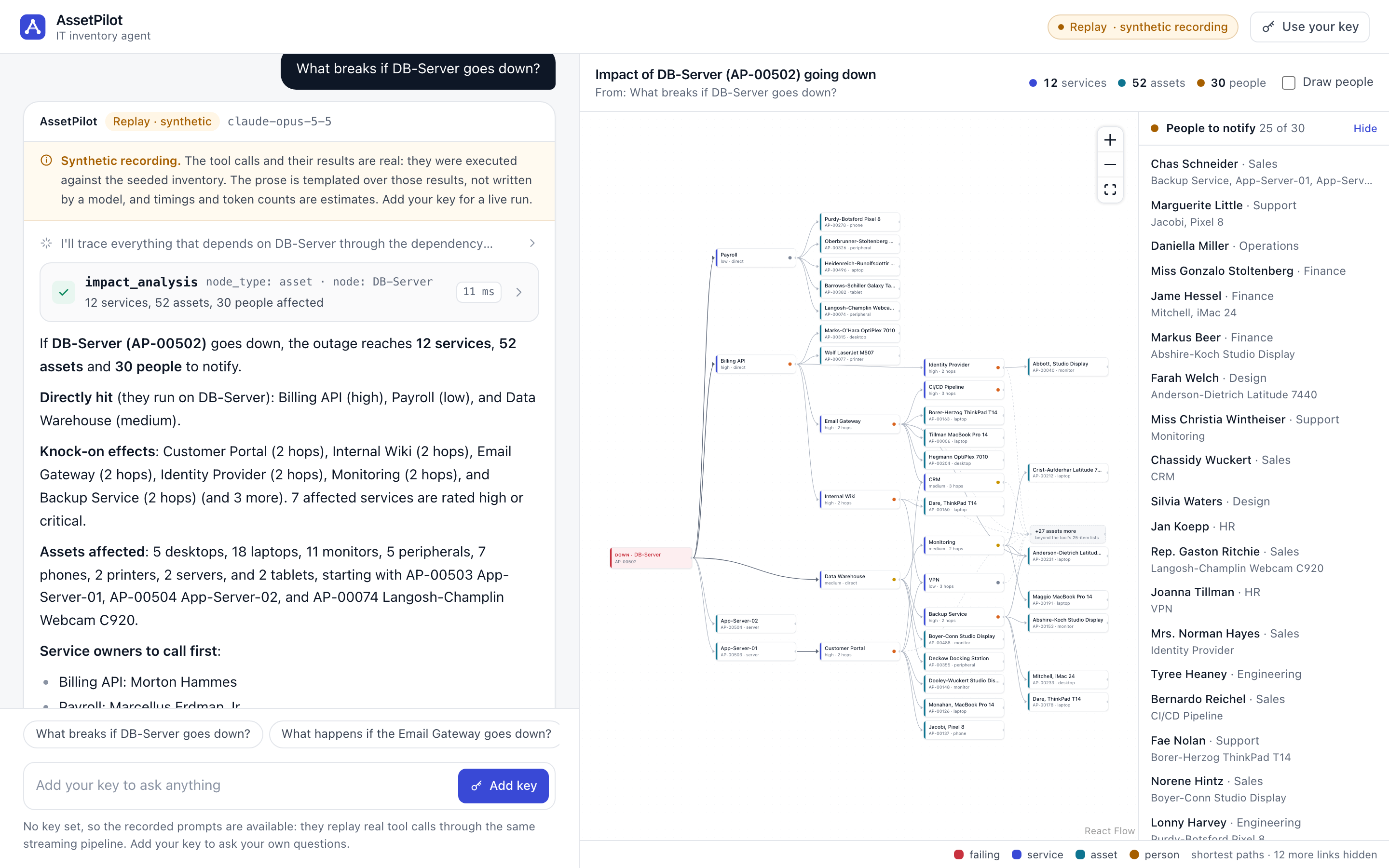
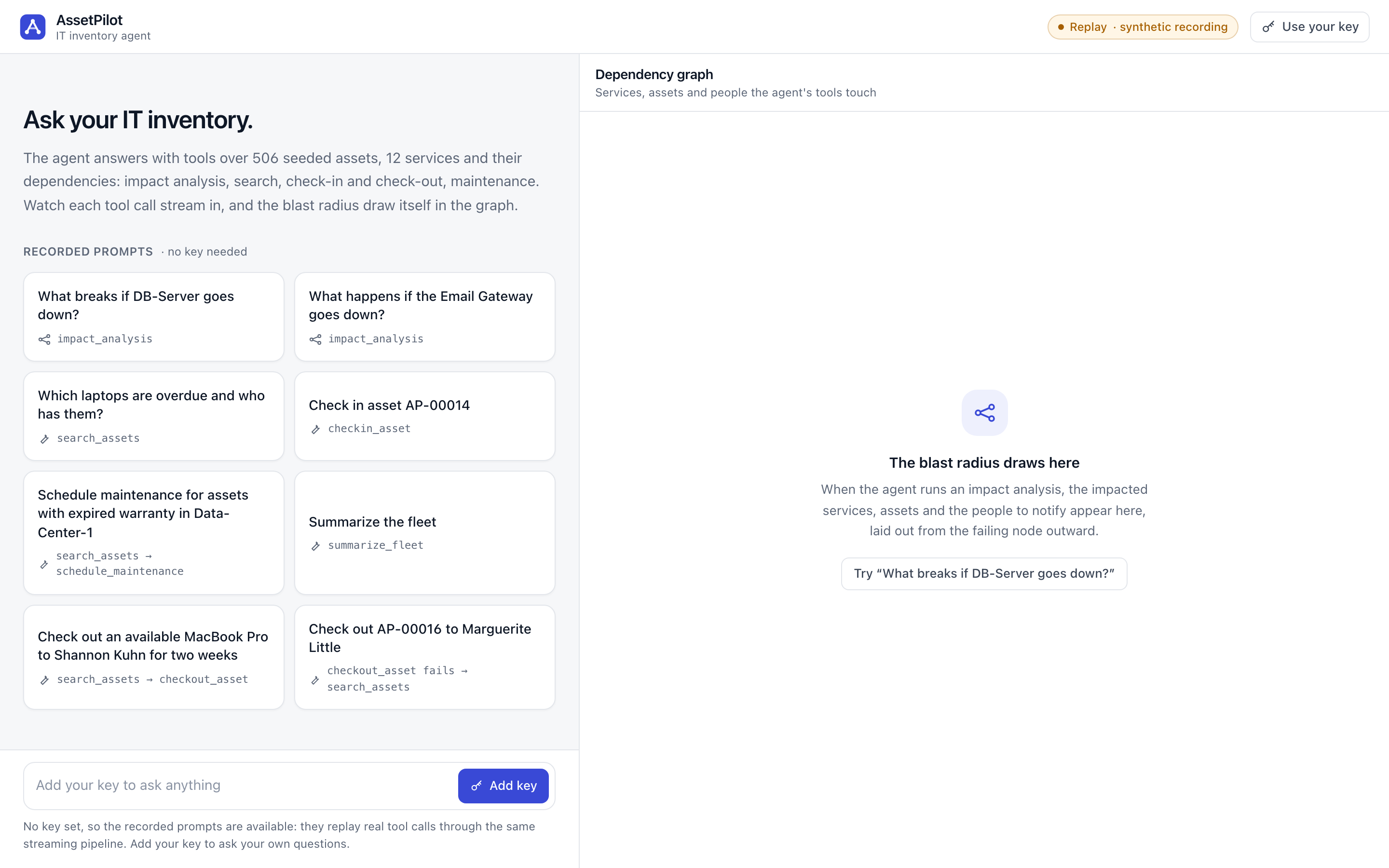
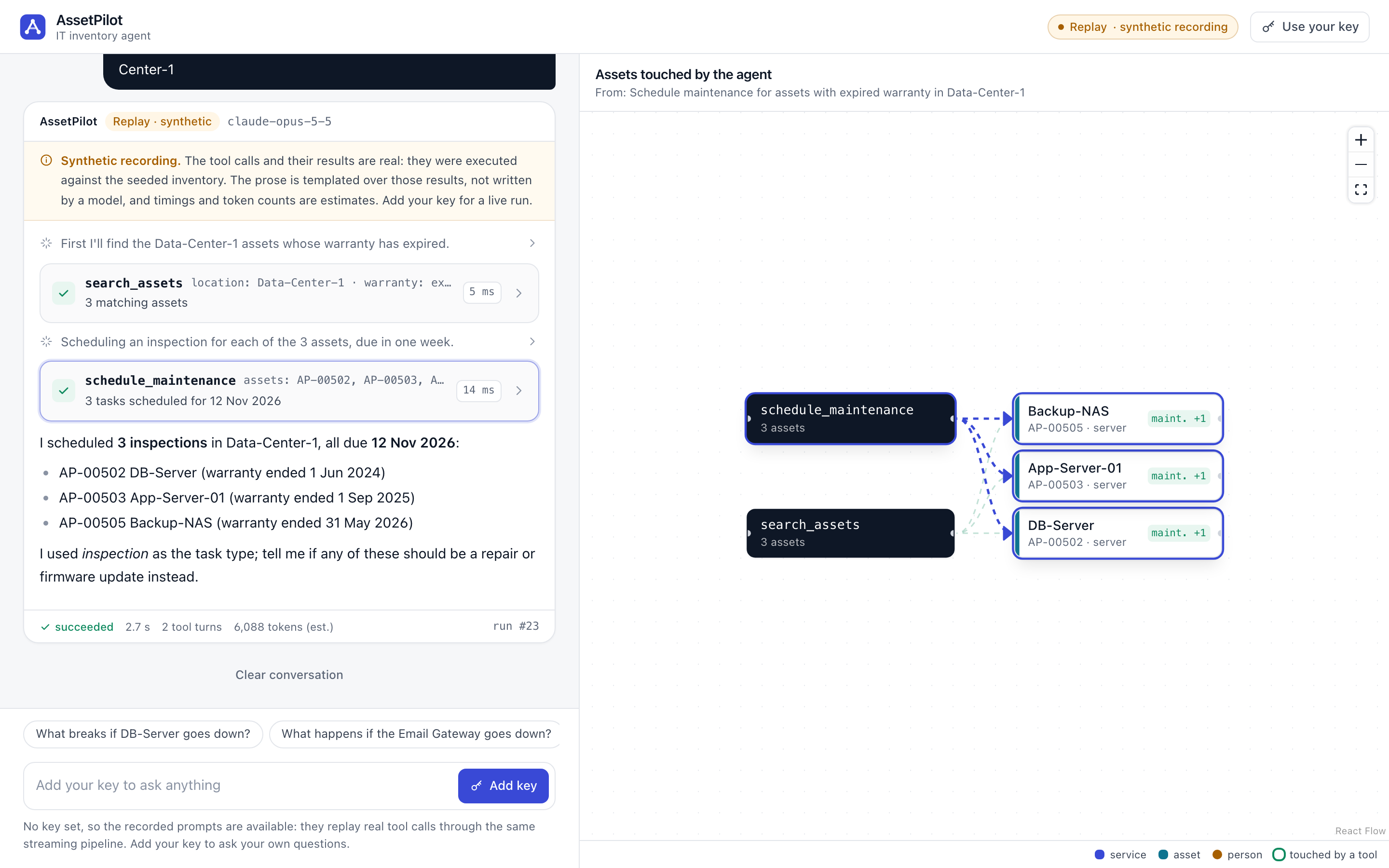
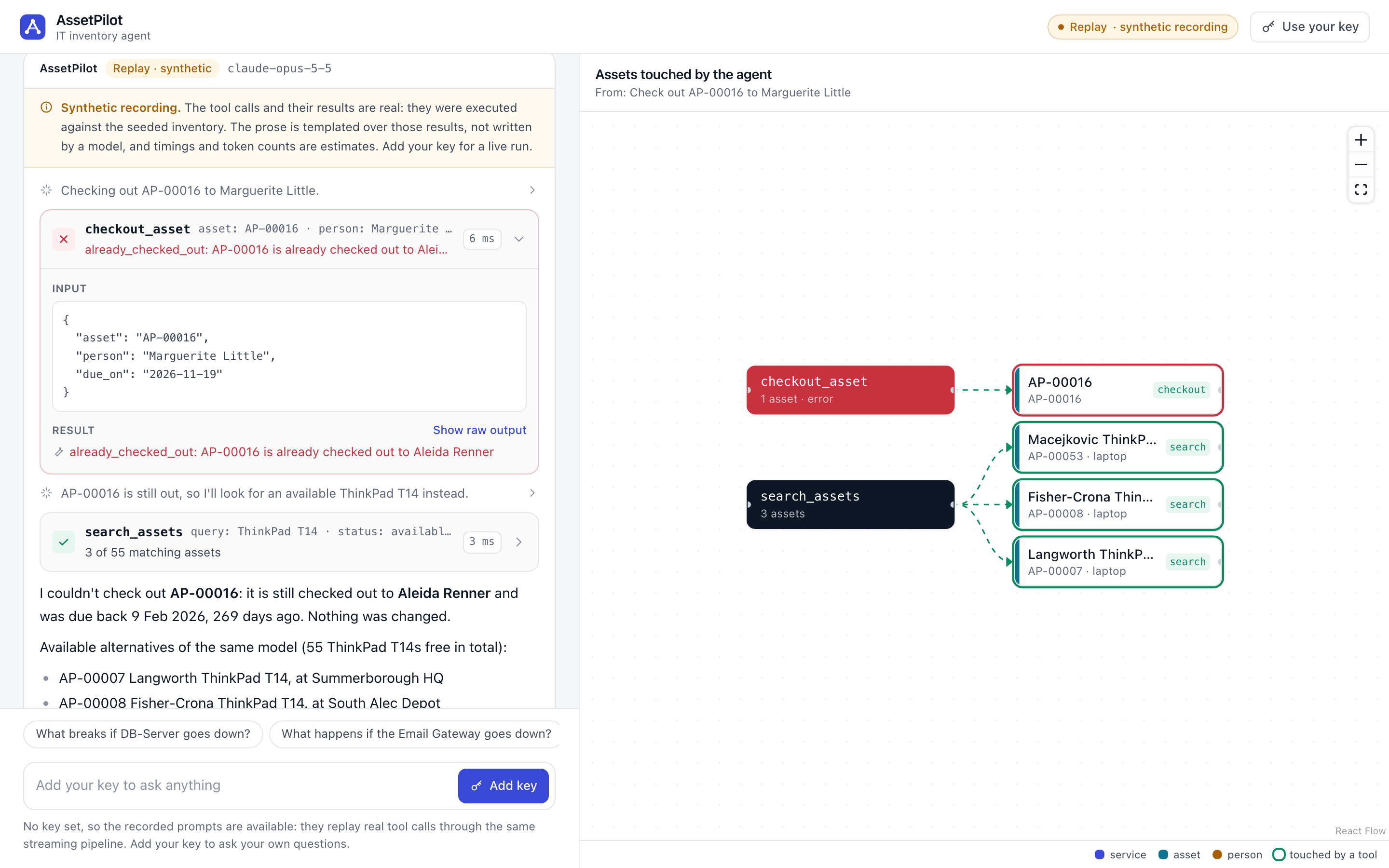
frontend/ is a React 19 + Vite + TypeScript + Tailwind app over the agent API: a chat that streams
the agent's work, and a live dependency graph of what its tools touch.
 |
 |
 |
 |
- Chat. The 8 recorded prompts are starter cards (and chips afterwards). Answer text streams in as
markdown; the model's
progressnotes are collapsible one-liners; each tool call is a card with its name, input, a result summary, ok/error status and duration, expanding to the input JSON and raw output. Free text is enabled only when a key is set; without one the composer explains that replays are available. - Dependency graph (react-flow, dagre left-to-right layout). An
impact_analysisresult draws the failing node, the impacted services and assets by hop distance, and an overflow node for whatever is beyond the tool's 25-item lists. Edges come fromGET /api/impact/:type/:id, which returns the subgraph with itsedges; only shortest-path edges are drawn (the rest are counted in the legend), which keeps ~60 nodes readable. People to notify are listed in a collapsible column beside the graph (a drawer below it on narrow screens), never over it; the canvas re-fits when the column opens. They can also be drawn as nodes. Assets touched by the other tools (search, check-out/in, maintenance) are highlighted, anchored on a node per tool call; a failed call is marked red. Hovering a tool card highlights the nodes it produced. - BYOK. The settings dialog keeps the key in
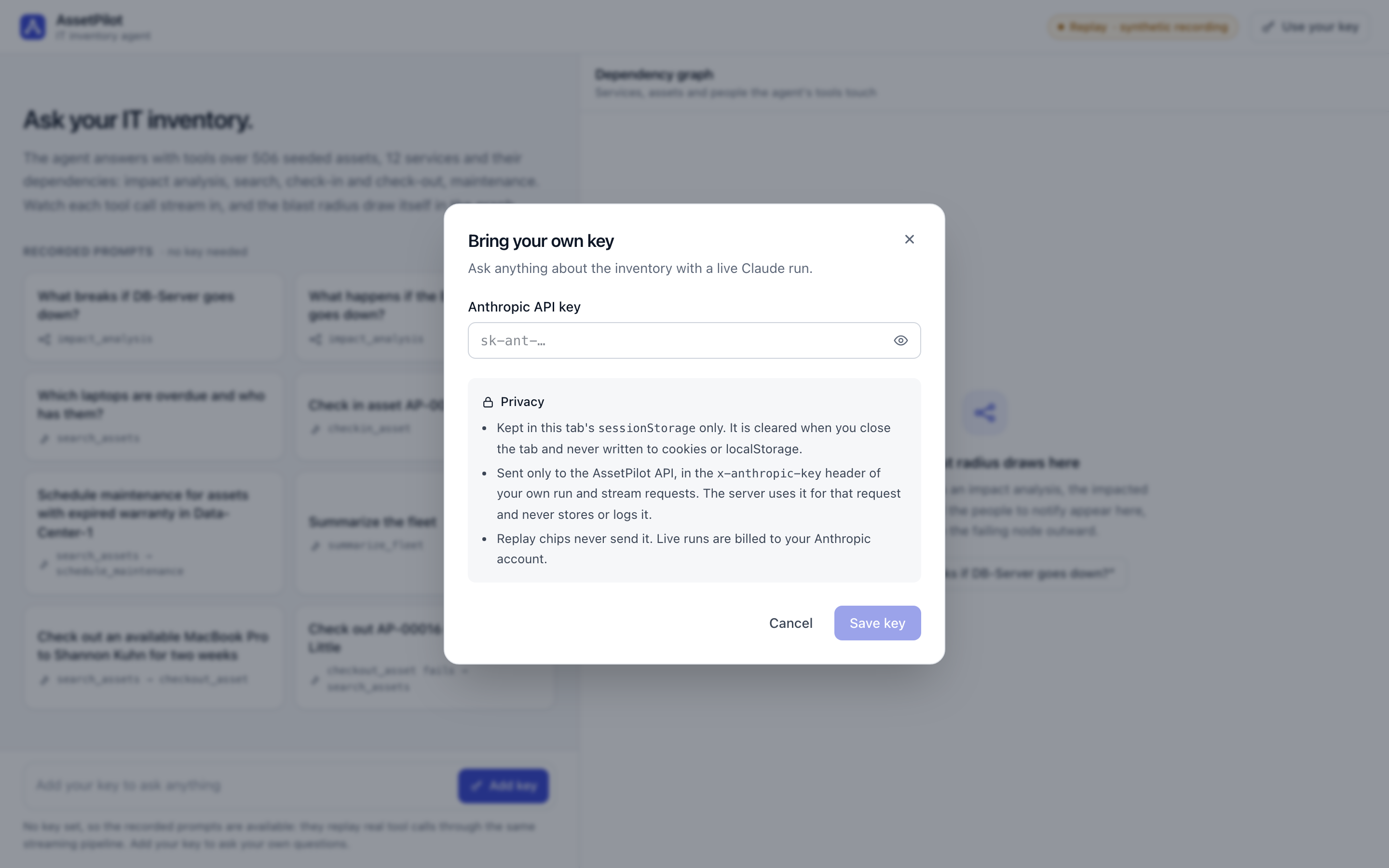
sessionStorage(this tab only) and sends it asx-anthropic-keyon both the create and the stream request; replay chips never send it. The stream is read withfetchand a small SSE parser (src/lib/sse.ts), becauseEventSourcecannot send headers. The header badge reads Replay · synthetic recording or Live · your key. - Honesty. Every replayed answer carries a visible label: the tool calls and results are real against the seeded data; the prose is templated, and timings and token counts are estimates.
bin/rails s -p 3100                   # the API (Postgres from docker-compose)
cd frontend && npm install && npm run dev   # http://localhost:5173, proxies /api to :3100
VITE_PROXY_TARGET changes the proxied API in development. A production build calls VITE_API_URL
(empty means same origin), and Rails must then allow the frontend origin: set CORS_ORIGINS
(comma-separated; in development it defaults to the Vite dev and preview ports). Append ?speed=4 to the
page URL to replay faster.
npm test               # Vitest: SSE parser, run reducer, graph model and layout (over db/replays/*.json)
npm run lint && npm run typecheck && npm run build
npm run screenshots    # headless Chromium against a running app: replays 4 prompts, checks BYOK headers,
                       # fails on console errors or a graph node hidden under an overlay; writes docs/screenshots/
npm run screenshots uses playwright-core; point CHROMIUM_PATH at a Chromium binary if Playwright's
own is not installed. Lighthouse on the production build (vite preview): 100 performance,
100 accessibility, 100 best practices (mobile and desktop presets).
AssetPilot ships an MCP server (official mcp Ruby SDK) that exposes the
same seven tools as the agent. It wraps Tools::Registry (app/mcp/assetpilot_mcp.rb), so names,
descriptions, JSON schemas and the mutating flag cannot drift from the agent's. Read tools are annotated
readOnlyHint: true; checkout_asset and checkin_asset are destructiveHint: true, schedule_maintenance
is a non-read-only, non-destructive write. It also serves a resource, inventory://summary.
Failed tool calls come back as isError results carrying the same {ok:false, error:{code,message,details}}
JSON the agent sees. Nothing here installs or edits any client config; copy what you need.
Prerequisites: the database is up and seeded (docker-compose up -d db, bin/rails db:setup), and ruby
on the client's PATH is the project's Ruby (3.2.3) with bundle install done. For GUI clients that do not
inherit your shell PATH, point at a wrapper script that selects Ruby first.
claude mcp add assetpilot -- /ABS/PATH/TO/assetpilot/bin/mcpbin/mcp boots Rails, writes only JSON-RPC to stdout and everything else (logs, warnings) to stderr.
It uses RAILS_ENV=development unless you set it. Set MCP_ALLOW_WRITES=0 for a read-only stdio server:
claude mcp add assetpilot-ro -e MCP_ALLOW_WRITES=0 -- /ABS/PATH/TO/assetpilot/bin/mcpRails mounts the server at /mcp (stateless, JSON responses). Over HTTP it is read-only (the three
mutating tools are not even listed) unless MCP_ALLOW_WRITES=1. Set MCP_TOKEN to require
Authorization: Bearer <token>. If you serve it under a non-localhost name, list it in
MCP_ALLOWED_HOSTS (comma separated), the transport's DNS-rebinding guard rejects unknown Host headers.
MCP_TOKEN=s3cret bin/rails server -p 3000
claude mcp add --transport http assetpilot-http http://localhost:3000/mcp --header "Authorization: Bearer s3cret"Add to claude_desktop_config.json (Settings, Developer, Edit Config), then restart Claude Desktop:
{
  "mcpServers": {
    "assetpilot": {
      "command": "/ABS/PATH/TO/assetpilot/bin/mcp",
      "args": [],
      "env": { "RAILS_ENV": "development" }
    }
  }
}
Try: "What breaks if DB-Server goes down?" (calls impact_analysis) or "Summarize the fleet".
The 60-second demo script is in docs/mcp-demo.md; the combined web UI + Claude Code GIF shot list is in docs/demo-gif.md.
Live results are pending. No Anthropic API key was available when the evals were built, so the agent
has not been run against them yet. What is in the repo, and runs in CI, is the offline check described
below. It shows that the cases and graders are sound. It does not measure the model. To get real numbers,
run ANTHROPIC_API_KEY=... bin/evals --live (or trigger the evals-live CI job) and commit
evals/results/<date>.json.
evals/cases.jsonl holds 55 cases, one JSON object per line. Each is grounded in the deterministic seed data
with the clock frozen at the replay instant (2026-11-05 10:00 UTC), so "overdue", "expired" and "two weeks
from today" never drift.
| Tag | Cases | What it probes |
|---|---|---|
| read | 26 | search, get, summaries; the read-only side of impact and error cases |
| write | 20 | check-out, check-in and scheduling, graded on the database state they leave behind |
| impact | 12 | impact_analysis by asset and by service, counts, owners, unknown nodes |
| error-recovery | 7 | already checked out, not checked out, unknown tag, location or service, past and too-long due dates |
| ambiguous | 6 | two people named Kuhn or Fransisca, two assets with the same name, "the MacBook", "the server", no target |
| refusal | 4 | delete assets, retire an asset (no tool), a prompt-injection bulk checkout, passwords |
| out-of-scope | 3 | weather, poetry, trivia: no tool calls at all |
Tags overlap (impact cases are also read; mutating error cases are also write).
{"id": "checkout-conflict-ap-00016", "prompt": "Check out AP-00016 to Marguerite Little", "tags": ["write", "error-recovery"],
 "refs": {"assets": {"AP-00016": "exists"}, "people": {"Marguerite Little": "exists"}},
 "expected_tools": {"order": "ordered", "calls": [{"name": "checkout_asset",
   "args": {"asset": {"regex": "^AP-00016$", "flags": "i"}, "person": {"regex": "marguerite", "flags": "i"}},
   "outcome": {"error": "already_checked_out"}}]},
 "expected_outcome": {"db": [{"type": "unchanged"}]},
 "answer": {"includes": ["Aleida Renner"]},
 "oracle": {"calls": [{"name": "checkout_asset", "input": {"asset": "AP-00016", "person": "Marguerite Little", "due_on": "2026-11-19"}}],
            "answer": "I couldn't: AP-00016 is still checked out to Aleida Renner. Nothing was changed."},
"replay": "checkout-conflict-ap-00016"}expected_tools.callslists the required calls,ordered(a subsequence of the actual calls) orunordered. A call can be{"any_of": [...]}. Extra read-only calls are allowed. Mutating tools that are not named are forbidden, unlessforbiddenlists the forbidden tools explicitly.max_callscaps the number of calls.- Argument matchers: a bare value (exact),
{"regex", "flags"},{"subset"}(array or object),{"set"}(an array in any order), or{"absent": true}. outcomefor each call isok(the default),any, or{"error": "<code>"}.expected_outcome.dbholds the database assertions:unchanged(optionally limited to some tables),asset_status,open_checkout(person: nullmeans none),checkouts_created,checkouts_closedandmaintenance_created(counted against a snapshot taken before the case). Cases without mutating tools get an implicitunchanged.answer.includes: facts the final answer must state, as case-insensitive regexes. They are kept loose ("12" or "twelve").oracleis a reference trajectory, andreplaylinks adb/replaysrecording. Both must pass.
Grading is deterministic (Evals::Grader) and scores seven dimensions. A case passes only when all seven pass:
| Dimension | Passes when |
|---|---|
| run | the run ended with the expected status (succeeded) |
| tools | the required tools were called, in order for ordered cases |
| args | ... and their arguments satisfy the matchers |
| outcome | ... and each matched call ended as expected (ok, or the given error code) |
| hygiene | no forbidden tool was called, the case stayed within max_calls, and no failed call was repeated unchanged |
| db | every database assertion holds after the run |
| answer | the final text contains every answer.includes fact |
tools, args and outcome are nested, so the first one that fails shows where the trajectory went wrong.
API failures (a rejected key, rate limits, 5xx, connection errors) are recorded as error, not as a failed
grade, and a rejected key aborts the run.
Optional LLM judge (--judge, live only): Evals::Judge grades answer quality against a fixed rubric
plus an optional per-case judge rubric. Its criteria: no invented facts, the result comes first, errors are
explained with a next step, it asks when the request is ambiguous, it refuses out-of-scope requests briefly,
and it claims no unconfirmed changes. It uses claude-haiku-4-5, a separate model that is cheaper than the
agent's claude-opus-5-5, with structured output (output_config.format). The transcript is passed as
untrusted data. Set EVAL_JUDGE_MODEL=claude-sonnet-5-5 for a stronger judge. The verdict is reported next to
the deterministic grade and never changes it.
bin/evals                    # offline without ANTHROPIC_API_KEY (live when the key is set)
bin/evals --offline          # force offline
ANTHROPIC_API_KEY=... bin/evals --live [--judge]   # calls the API for every case; costs money
bin/evals --tag write --only checkin-ap-00014,overdue-laptops --no-write
Offline (the default without a key; this is what CI runs, and it must pass) checks the following for every case:
- the structure and tags are valid;
- every tool and argument exists in the tool's JSON schema, literal values satisfy it (enums, date formats), regexes compile, and error codes are real;
- every asset, person, service and location in
refsresolves in the seed as declared (exists,missingorambiguous), using the same lookups the tools use; - the oracle trajectory, run against the real tools, passes the grader, which shows the expected tools, arguments, outcomes and database state are reachable;
- an empty transcript fails the case, so no case passes a no-op;
- the linked replay passes.
Live runs each case through Agent::Runner (the same model, effort and tools as the app) inside a
savepoint of one rolled-back transaction, with the database reseeded and the clock frozen. Mutating tools
really execute, and nothing survives the run. Each result has the transcript, the per-dimension grade, the
database assertion details, token usage and an estimated cost.
Both modes write evals/results/<date>.json (offline: <date>.offline.json) and a .md copy of the summary
table, and exit non-zero unless every case passes. Current offline result:
evals/results/2026-11-05.offline.md has 55/55 oracles passing and
55/55 empty transcripts rejected.
The graders are self-tested in spec/evals/. That covers 20 transcript fixtures that must pass or fail on
specific dimensions (spec/fixtures/evals/transcripts/), validator specs that feed in broken cases, and a
live-mode spec that drives the real runner with a scripted model.
CI: evals-offline runs on every push and pull request. evals-live runs only on workflow_dispatch
(Actions > CI > Run workflow, with an optional judge toggle) and is skipped unless the ANTHROPIC_API_KEY
repository secret exists. Both upload their results as an artifact.
Prepared but not deployed. The repo has the config for a free-tier setup: Supabase Postgres, the Rails API on
Render (render.yaml, native Ruby runtime, migrations and a first-boot seed in the start command) and the
frontend on Vercel (frontend/vercel.json, VITE_API_URL). The step-by-step guide is in
docs/deploy.md. Production boots in replay mode with no Anthropic key; visitors can bring
their own. script/production_check boots the app the way Render does, against a local database, and
checks that it works. Render's free plan sleeps when idle, so the first request after a while takes about
30-60 s.
- M1: domain, seeds, REST API, impact analysis, specs, CI.
- M2: the agent. Natural-language Q&A and tool-using actions over SSE, BYOK, replay mode.
- M3: React UI (
frontend/) and an MCP server exposing the same tools. - M4: evals for the agent (Evals) and deploy prep (docs/deploy.md).
MIT